This day started off very slow, as us level designers had little to do due to the rooms having been decided now. However, things changed later on when we were given the prototype for the room randomizer and spawner from one of our programmers. With this we could try out how our rooms would look and how we properly implement them into the system.
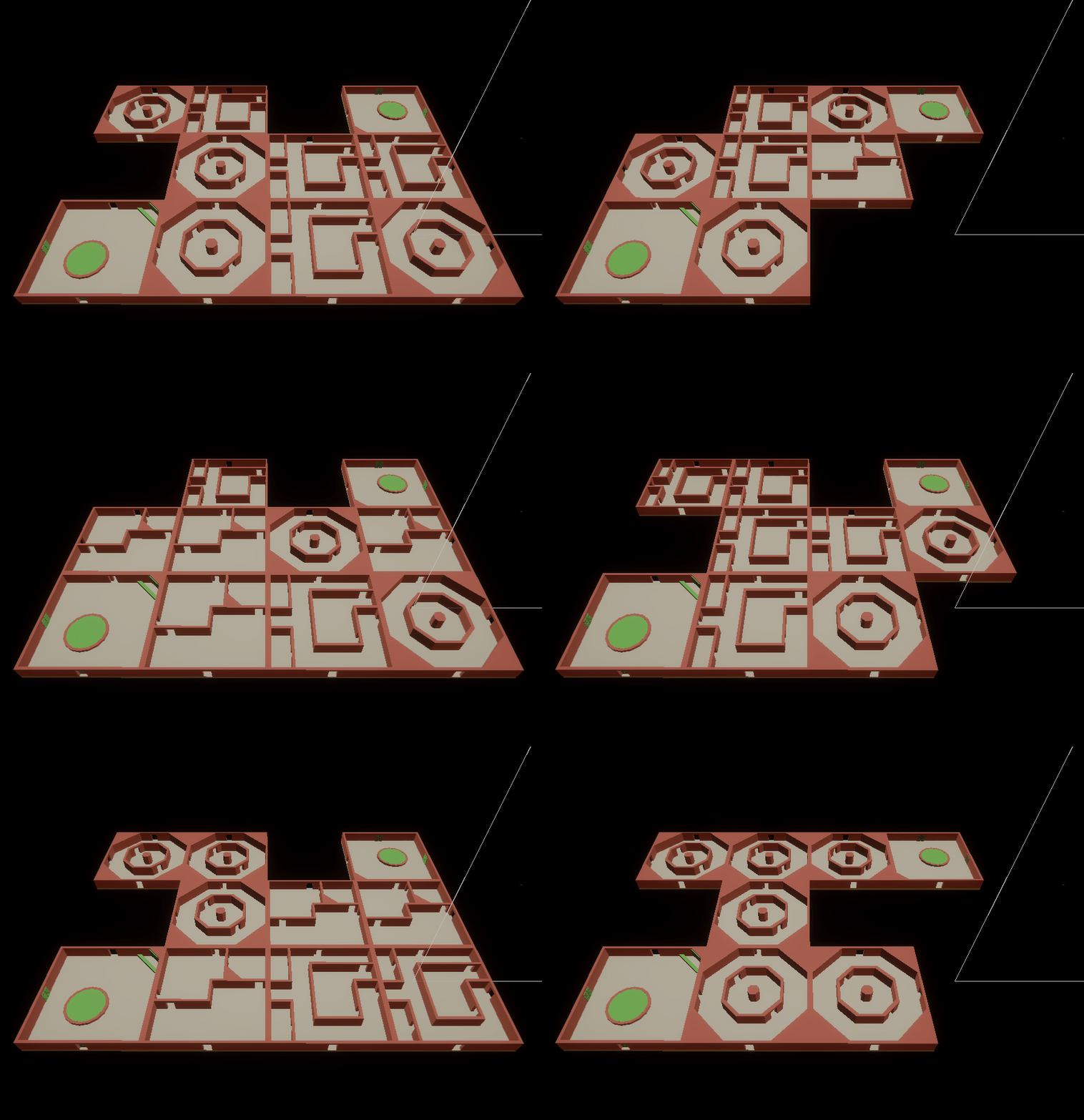
Example of the spawn and randomizing system.
In the example I have thrown in my three chosen rooms along with a placeholder I made for the lobby. So far the system doesn’t rotate the rooms, but that is something the programmer will work on later, focusing on more pressing matters at the moment.
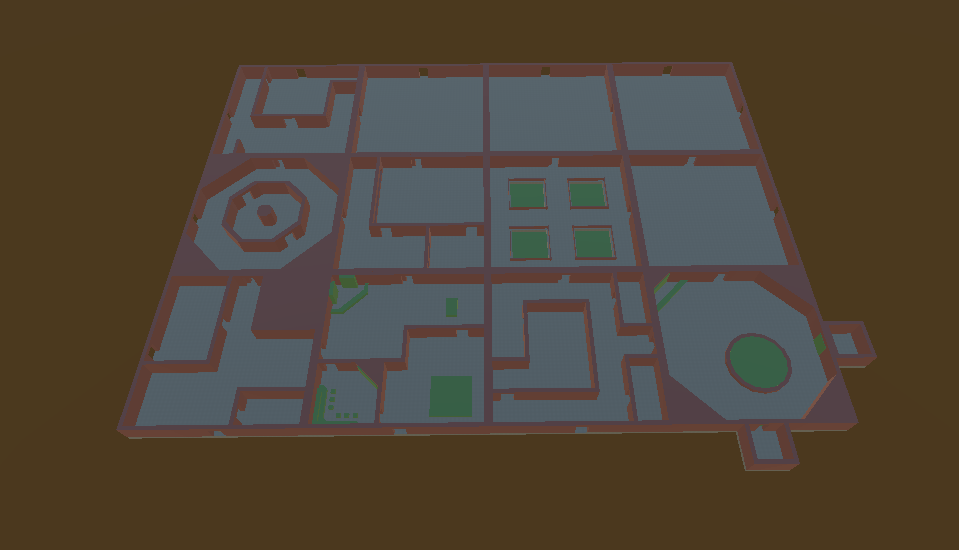
After having that system figured out, me and my fellow level designer were tasked with mapping out potential spawnpoints in the rooms. This was done to help our gameplay designer to get some ideas for how and where to spawn all of the enemies in each room.
One of the designs I made.
Now, not all of the spawnpoints will spawn an enemy, as we have a system where a certain number of enemies can spawn in a room. This system then chooses which spawnpoints to spawn enemies from with the spawnpoint determining what type of enemy is spawned. The number of enemies in each room also increases the further into the game the player gets, as well as an increased chance for more powerful variants to spawn.
Other than that, we have looked a bit into feedback for the game, but will likely get to work more in depth with it tomorrow.
Today was the day we decided on which rooms to bring into production.
There were plenty of discussing between all of us designers as to which rooms me and my fellow level designer should bring before our level- and environmental artists. We where supposed to cut them down from fourteen rooms to ten, but only managed to cut it down to twelve. The inability to cut down two additional ones was due to all of the levels still having their strengths and we didn’t want to keep them waiting for too long. Once we had our meeting with the artists, we managed to combine a few rooms into more interesting ones, which had positive results. Along with that, they helped us greatly in reducing the number of rooms we had resulting in us being left with the six rooms we had originally planned for. However, there were rooms that they still liked and wanted to keep on the backburner for if we add more rooms in the future.
The clear rooms were chosen, the ones covered in red were not and those circled in orange are the ones we might add later.
Additionally, the fifth room by my level designer comrade was combined with elements from my third room, adding small gardens to it as obstacles to empower the ranged enemies a bit whilst also enhancing the calm feeling of the room.
My third room that was used for room five.
My fifth room was also revised to not feature the intended bar theme and instead proceeding with it being a workspace with an interesting layout. This was fine by me though, as I went into designing my levels with the mindspace of letting the decorations be left to the artists to decide. I wanted to mostly stick to what would work best for the gameplay rather than how it should look.
How my fifth room looks now
The reasons for the chosen rooms being chosen was to have a good spread of various rooms, with three workspaces, two relaxing rooms and one sort-of in-between space room. This in-between space was my fellow designers sixth room, featuring lots of corridors. They said that they designed the room with tight spaces in mind to challange the player by limiting their mobility. But through a few revisions, the room is now a bit more open with more pathways, whilst still retaining the enclosed nature of corridors.
The more relaxing rooms chosen were my first room and my fellow designers fifth room merged with my third. The reasoning behind my first room was that the middle piece could very easily be replaced with a statue of sorts, making the whole room feel more like a place of appreciation for the enemy’s leader. As for the fifth room, the room was already very calm and relaxing featuring a centerpiece made for relaxation. But the room felt too open as it was, and expanding the centerpiece would just limit the players mobility further. So instead we opted for adding the small gardens of my third room into their fifth room to make it less empty whilst only limiting the players mobility slightly.
For the workspaces we chose my fifth and sixth rooms and the other designers third room. Starting with the latter, the third room was chosen due to already being designed as a workspace, namely a conference room. My two rooms were chosen, however, due to their layout being more intriguing than the other options and could easily feature a couple of workspaces, tables and so forth. But as previously stated, my fifth room was redesigned for this purpose.
Moving away from the choice of rooms, I have also been further researching Holistic Level Design via a GDC by Steve Lee. The video is very informative and has really helped me get a greater understanding of level design as a whole. I have also begun revising the levels which were scrapped to enhance them in-case we want more levels further down the line.
With that ends this day, which I personally felt was very productive even though not much was done. Mostly because a pretty big matter was settled with the room layouts and now we wait for our level- and environmental artists to create a tileset to use in the rooms.
There has been plenty of further discussions regarding art-direction with both how characters should be designed as well as the environment. Along with that, the artists had a big meeting where they made their own moodboards to see who had the most concrete vision of how the style of the game should be. After said meeting was over, it felt like most of our artists where on the same page about the style the game should have.
As for my own work, most of today has been spent discussing with the other designers as well as level artists to get a better grip of the art style. Apart from that, I have also been further iterating on my rooms as well as started to design new ones. The new rooms are the in the top-left and bottom-right in the picture bellow:
The current state of my rooms.
The top-left room is meant to be the groundwork for what will be a dojo, or at least it’s dojo-inspired. Much like with most of the other rooms, I wanted to have some seperations between large, open spaces for combat, so the player can route the enemies without too much issue. The bottom-right is one of the lobbies we are supposed to design and are the entries and exits from each of the floors. With this design I wanted to keep it simple and lobby-like but with room for free movement to test out your recently aquired abilities. This design also leaves a lot of room for the artists to freely decorate as they see fit.
We also had a small discussion regarding mine and my fellow level designers rooms regarding how well they have been improved by the feedback we were given. Overall it didn’t feel like too much of a productive day, but I plan on doing better tomorrow by further working on the dojo room.
Today has been very slow, as most Mondays tend to be. We started the day off by having me and my fellow level desinger show off the different rooms we have come up with. We listened to feedback, discussed solutions and overall just discussed design. Afterwards I began to redesign the rooms that I had gotten feedback on what didn’t work and sought to fix it.
Old versionNew version
The change in the upper-left room was due to it feeling too open and the center being a bit boring. To changes I made where therefor to make the center bigger and hollow, with only two entrances rather than the four leading into the room. This to give the player more places to go with somewhat tight corridors without making them too tight. The change in the lower-middle room was just replacing the big table with many smaller ones, as the big one limited too much of the movement in that room. It was a very minor change, but a change nontheless. The lower-right room was given a major makeover, to make it’s design look more natural and realistic by architectual design. It looks a lot better now, without sacrificing the design of limiting the view to the other entrances from the one entered.
Aside from that, most of today has been spent in meetings where various design things were being discussed. This due to our leads having a meeting with our teachers to show off what we have gotten so far. There has been some issues regarding our artists having gone in many other directions, but have resolved that issue and are now back into form.
That is about it for today. Very uneventful as Mondays tend to be, but I suspect the rest of the week to be more eventful.
Today’s end marks the end of the first week of project Blade. The week has gone well, though it has been slow thanks to both the virus panic as well as the project still being in pre-production.
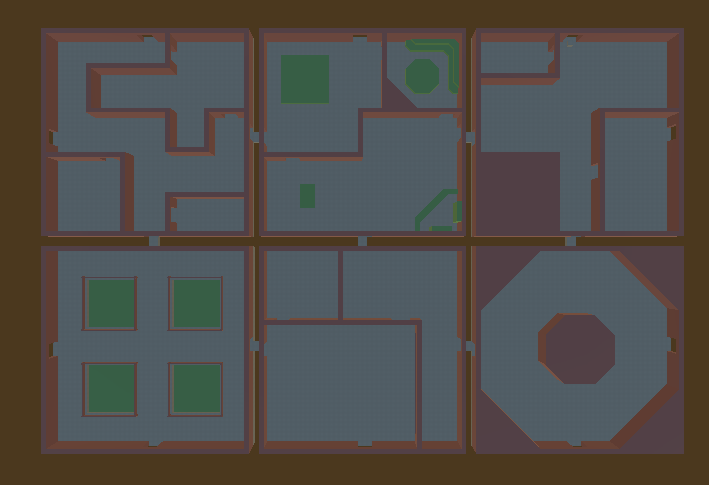
As for my own contribution for this week, I’ve managed to finish six rooms that I am kinda proud of, using the various methods of design I have researched these past days. Apart from that, I have also watched a bit of Holoistic Level Design to get a bit more knowledge about the topic. There has also been a lot of discussions regarding enemy designs, which ended with us changing our ranged drone enemy to ranged variants of the melee grunts we previously had. Though the compromise has been that the ranged variants has to be distinctly different from their melee counterparts.
The six rooms I have made so far.
Aside from that, the group as a whole has made plenty of headway towards being able to enter production, with many character concepts and environments as well as a more fleshed out GDD. The levels that me and my fellow Level Designer has managed to make also have gotten somewhere and we’ll probably get to deciding which should be in the game soon.
But with that starts the weekend and next week we continue the pre-production until we’re finally ready for full production!
As the second day of working from home comes to a close, it’s time to update this design blog.
Most of today has consisted of discussions regarding design of the levels as well as of the enemies we want in the game. The level design discussion in particular took quite some time, having bled over from late yesterday, and regarded the symetry of the rooms. Due to how the randomized system we are going to use for the game, we have chosen to make rooms square and with a door in the middle of each wall for simplicity’s sake. This due to needing the system early and not wanting the programmer to be stuck with making this one system work for the entirety of the project. However, our level- and environmental artists disliked the symmetry of the rooms and wanted them more asymmetrical, specifically the doors. But after a lot of discussion including weighing the opportunities versus the risks of an asymmetrical design, we managed to come to an understanding and will proceed with the current layouts. With some compromises to make the rooms feel less symmetrical than they actually are.
Some of the experimenting I have been doing today
Apart from that, I have been doing some more research of level design. Today specifically I chose to watch a GDC about negative spaces and how it impacts the game. I’ve taken the negative spaces into consideration when designing a few more rooms during the day, as well as the ten principles I learned from yesterdays research. I have also been looking over some blueprints of office buildings and how they look from both symmetrical and asymmetrical angles to get a better idea of breaking the symmetry of the rooms a bit.
The level- and environmental artists have also been doing a lot of reasearch as well as begun making tilesets for us designers to test out in our geryboxed rooms. Though there has been some struggles due to lack of hardware, but it should all be sorted out very soon. The programmer asigned to making the level-generator has also finished an early version of it, allowing for testing once we have functional levels for it. Having it done early also allows for plenty of testing and bugfixing later on.
Meanwhile, the other teams have been working hard as well. The character artists have continued their work on the artguide and are concepting enemies after the choices of us designers. The gameplay designers have also been hard at work designing said characters as well as the upgrades we will be using later on. Our lead-designer has also been editing the GDD a lot to further reflect the vision of the game. The programmer responsible for the player character’s code has been hard at work and have managed to get a lot done so far.
With that ends the fourth day as well as second day of us being home due to the virus. There has been a few ups and downs, but we are progressing as planned and are slowly but surely getting there.
The first day of working from home has begun and so far, so good. It has been weird talking to each other over the web rahter than person to person, but we have made due. The workflow has definitely been slowed down by the lack of accessability to our usual software, but it is being worked on and we’ve done the best of the situation.
As for the actual work having been done, us designers have had plenty of discussions regarding how to proceed with enemy designs and level design, amongst other general design discussions. When we haven’t been discussing design though, I’ve been doing further research on level design, specifically a GDC about the ten principles of good level design. So far it has really helped me to get into gear of how to design the rooms. I’ve also been trying out various designs of the rooms to see what could work and in what ways. Specifically I’ve had the approach of wanting the player to see the enemy beyond a counter, to give them time to prepare for combat by relocating or types of preperations. Alongside this, I want to retain as many open spaces as possible as to not limit the players movement with their abilities. Moreover and related to the open spaces, I have been deliberately trying to limit the amount of props I establish in each room, as to leave more of the interior design to the artists. Though if I want to have furniture specifically as obstacles, then I will establish them in the design.
A grey-boxed room of my making.
Aside from that, our team has made steady progress towards leaving the pre-production stage and entering the full-blown production stage. Our artists have made a lot of headway in establishing the artstyle and the feeling of the art in the game, resulting in a lot of concept art being made and reference pictures being thrown about.
Our programmers, meanwhile, have set up a temporary repository to utelize until we get access to all of our software so we can keep the workflow steady. Alongside that, they have been steadily working on the systems and AI for the game, in silence for the most part.
All in all, today has been messy. But we’ve made due and are ready to take on the next challange!
Today might be the last day spent at school for quite a while, due to the rapid spread of the virus. Due to that, most of the day has been a bit chaotic as we discuss internally how we will proceed.
As things stand, everyone who is able to work from home will do so, even if they have a hard time concentrating. That is a hurdle that we’ll have to overcome as there is no guarantee that the school won’t close down entirely for the duration.
But with the time we’ve had where we didn’t worry about the current events, we have managed to futher advance our plan for how we want to go about with the project. for example, we have properly divided everyone into proper feature teams, where I am in the level team. As a part of that team, us level designers have been doing plenty of research as well at testing to see how large we want each of the rooms to be. I, in particular, have been researching a lot of modern japanese architecture to get a good idea of how and where to place objects in each room to make each room seem more realistic.
The level and environment artists have been hard at work testing and creating their art-guide to have it finished before they begin working on the assets for the game. The programmer from our team meanwhile has been working hard on making a functioning level generator for us to place our rooms in and have randomly placed on the map.
The other feature teams, meanwhile, have been working on designing the enemies as well as augments to upgrade the players abilities and give them new ones. They have also been working a lot with the character artists to come up with good character designs for the enemies along with various ideas for User Interface elements.
But with that ends another day and a new time of struggle will begin.
Today is the start of what will be our second game project named Project Blade, a first person Rouge-like slasher for the Playstation 4. It will feature a modular system to randomly place pre-made rooms in a grid pattern as well as upgrades that stack with themselves which augment the player in various ways. Our team consists of five designers, three programmers and ten artists, making this team twice as big as the one we had for our first project. A few of the artists are ones I worked with in the last project, but apart from them the team is brand new for me.
Us designers have sat down and began to more thoroughly discuss the features we want and how exactly everything will work in the game. We have the design philosophy that the player should feel like a badass when killing enemies as well as always pushing forward through the opposition. This means that the player should never be incentivized to retreat but rather to always want to go on the offensive. With these in mind, we’ve made a system to make the player want to clear each floor by giving them more options for upgrades at the end of the level. This to make sure the player doesn’t grow too powerful by getting an additional upgrade but still incentivizing to kill every enemy to more easily get the upgrades they want.
The artists have begun constructing an artguide to help them unify in a single style and work from that later on. The style they’re going for is very cyberpunk with plenty of neon colors mixed with japanese elements such as tattoos and old japanese weaponry. They will also be doing a lot of research about how things should look and what elements they can bring to the game.
Programmers have begun working on the core features of the game, such as the room randomizer, enemy AI and player functions. The room randomizer will essentially place pre-made rooms on a grid, connecting the entrance and exit of the level.
Though most of these first weeks will only be pre-production for us designers and artists, both giving the programmers more time to fix the essentials as well as allow us to have a clear view of where we want to take the project.
And like that our presentations are over and so is the project. It has been a fun one and I feel like we truly did well. The gane we made is fun after all, and I can’t wait to see what Project 2 has in store.
But until then, this blog will remain stagnant unless I pick up a personal project. With that, merry Christmas and a happy new year!






 Emil "The Pagan's" Gamedev-blog